God’s Terroir – A Place to Flourish.
A Further Reflection on John 15
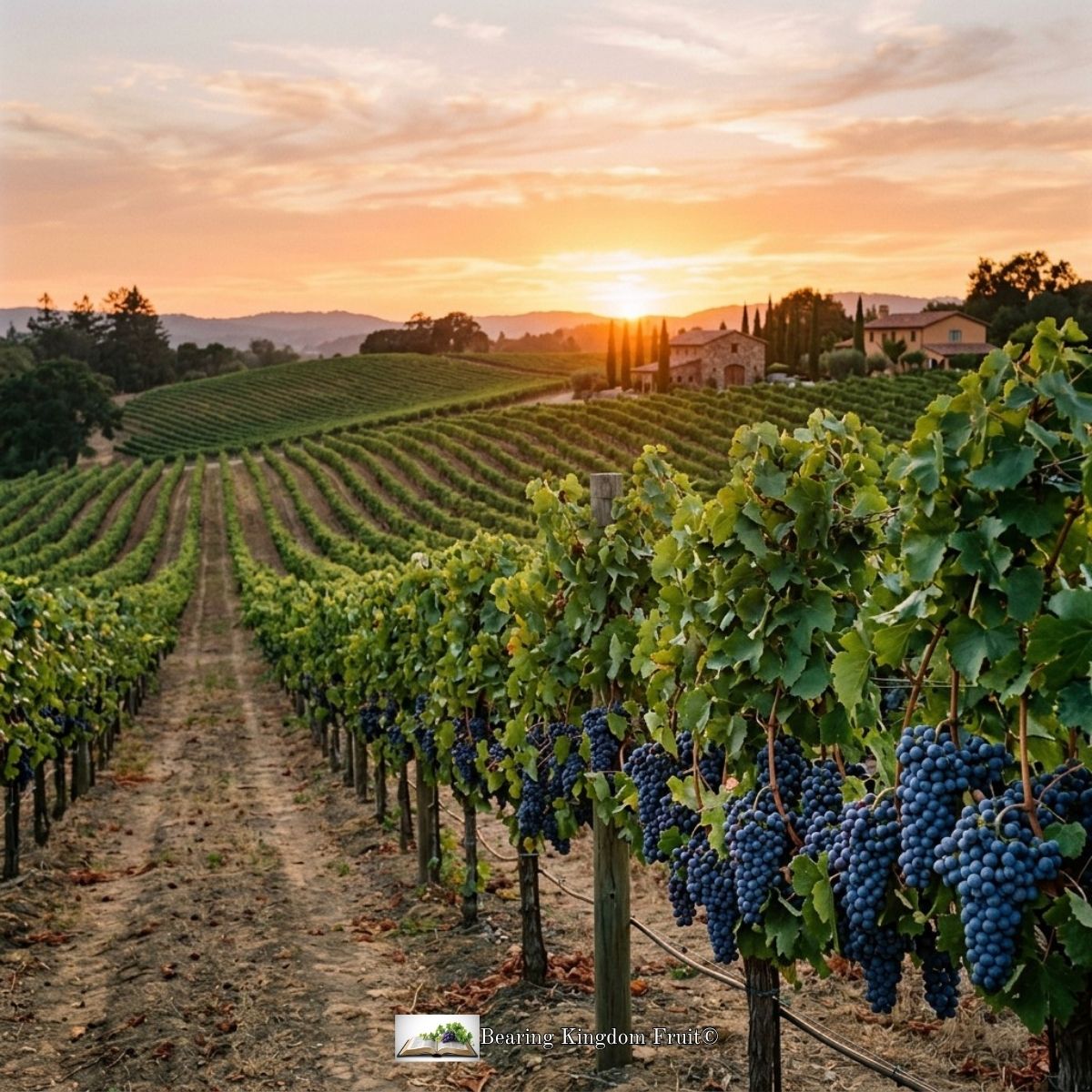
It is late afternoon towards the end of October. I’m standing in the square of a tiny village high on the limestone plateau that is the Quercy Blanc in Southwest France. Behind me the scrub forests of Quercus pubescens, the Downy Oak, are only just taking on their autumnal hues and have yet to give up their truffle harvest. Below me, from my lofty vantage point, I can see the River Lot winding its way through a wide alluvial valley. On either side of the majestic river, block after block of vineyards stretch over the valley, sprawling over the old river terraces and up the valley sides. Each grape variety is slightly different, even each block is slightly different, but all in colourful hues of crimson, pink, cream and yellow.
Their job done, the grapes safely harvested, the vines are now resting. Or are they? Already each grapevine is preparing for a new season, chemicals being withdrawn and stored for the new growth next spring. Though before then, winter pruning will dramatically change each plant’s size and shape. During each season the vineyard responds to the conditions it experiences, to produce a fruitfulness that then gets bottled and eventually savoured.
It was that view over the vineyards of the Lot Valley that ignited my interest in the concept of “terroir’. “Terroir” is a French world now adopted worldwide, which winegrowers love to talk about. One definition describes it as “the combined natural and environmental factors—specifically soil, climate, topography, and landscape—that give agricultural products, especially wine, a unique, inimitable character and “sense of place”. It defines how the specific environment influences a grape’s phenotype and flavour, often including human factors and tradition.” (Virgin Wines. (n.d.). Wine guide – advanced knowledge – what is the meaning of terroir? Virgin Wines. )
In a fascinating article in the Cider Review, (Russell-Smith, C. (2023, February 18). Rethinking terroir for the 21st Century. Cider Review. https://cider-review.com/2023/02/18/rethinking-terroir-for-the-21st-century/) Chris Russell-Smith tells how the monks of Burgundy began to document the differences between wines from different vineyards as long ago as the 14th century.
He goes on to say: “For the Cistercian monks, whose lives were structured by an all-encompassing religious faith, the only possible explanation for this magical metamorphosis was that God must have willed it. In the most fundamental sense, God was therefore the winemaker, and the variations between wines from different vineyards expressed the variegated contours of His creation.” I love that idea!
But I want to mention something slightly different. This is the concept that some refer to as a “Christian’s Terroir”, but I call “God’s Terroir”. God made each of us for a purpose, each one of us He calls to a fruitfulness that continues to mature as our faith and trust and relationship with Him grows ever stronger.
God provides for us our own unique “terroir” that nurtures and allows our fruitfulness to grow and strengthen in us, as we allow ourselves to be changed by Him, our Vinedresser.
The definition of a vineyard’s terroir I described earlier can be compared to this spiritual one chosen by God Himself for each one of us. God’s terroir can have four key components:
First there is a spiritual heritage we experience as we grow into fruitfulness. It is a combination of theological tradition (such as Pentecostalism) and what we inherit from an early age that starts us on our journey into faithfulness.
Second there is the effect of the community we grow up in – the local church, our family, significant people we meet physically or “follow” in the media, that form the culture we grow and develop in, our Christian identity.
Thirdly, there are the practices, the rituals, and traditions that shape our understanding, determining the nature of our faith and strengthen it.
Fourthly, there are our immediate surroundings, the physical location where we live out our lives daily glorifying God, The soil we grow in.
But there is a fifth. It is God’s love for each of us. To some degree we can ourselves determine the conditions we grow in, that produce our fruitfulness. But we cannot increase or decrease the love God has for us. He made each of us for His purpose and through His love he prunes and nurtures us, lifts up our dusty branches to the light, enables us to be the poerson He made us to be.
All these various parts, these influences, form our spiritual terroir. They are God’s provision as He purposes us, as He provides for us and equips us to be His hands, His feet, His voice. We produce His fruit for His purposes. As a result we flourish in that terroir and in the process we both fulfil our Father’s purposes and are ourselves fulfilled as we serve Him. Fulfilling, Fruitful, Fulfilled. And, yes, we can chose our terroir to a great extent, how much we allow our terroir to grow us into maturity. But we cannot stop God loving us, and we need to allow Him to be our Vinedresser.
All references are from the NKJV unless specified otherwise.
John Partis
bearing-kingdom-fruit.com
This article may only be reproduced, in print or on the internet, if the author’s name and website address are included at the end of the article. Thank you.