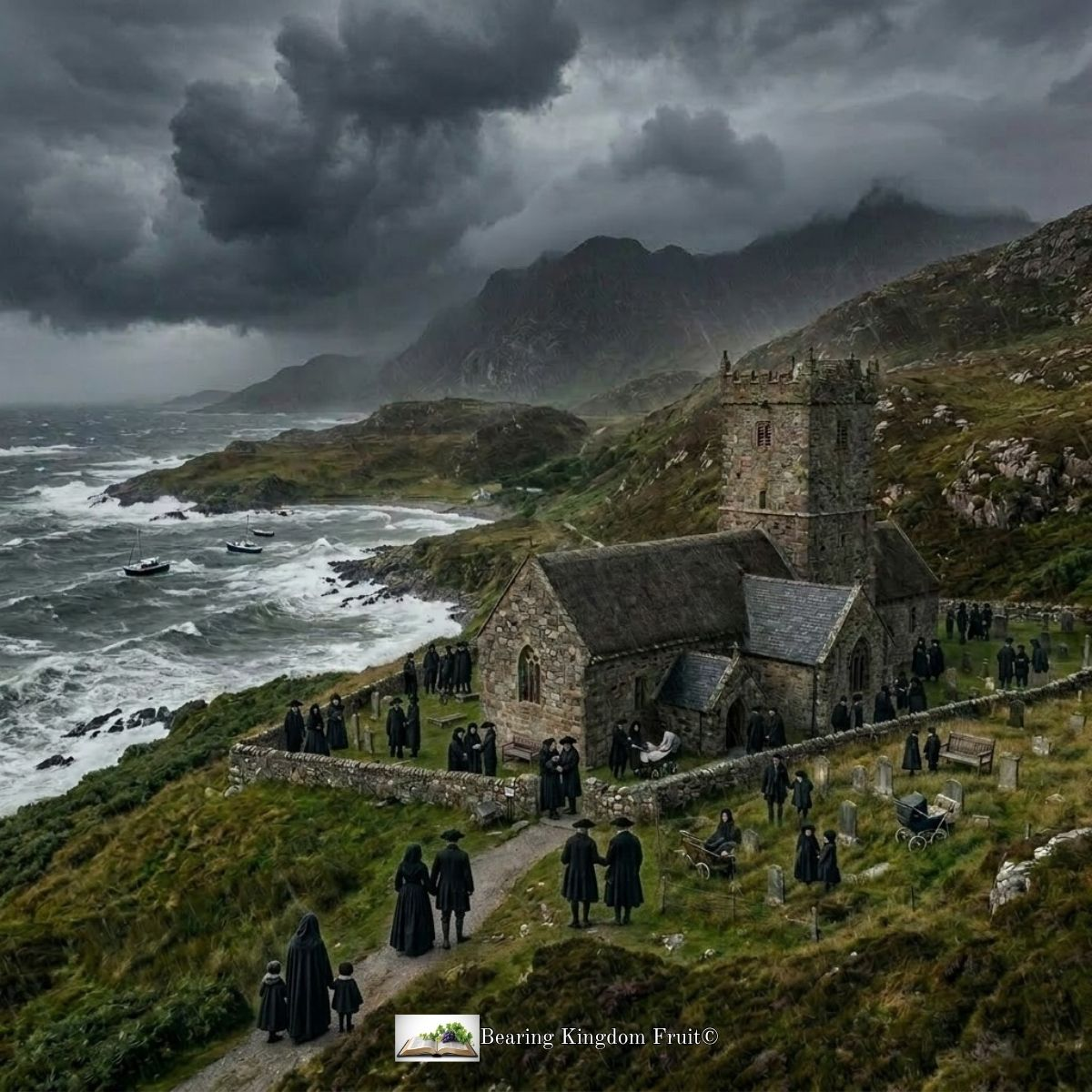
Here are a few lines I wrote long ago in 1974. I rediscovered them in an old journal while attempting some decluttering! The words were written immediately after visiting the medieval church of St Clements at Rodel in the Outer Hebrides. Rodel is a small village at the southern tip of the Isle of Harris. It has a picturesque harbour, long used by the local community for sea fishing – a dangerous occupation even now, but in the past even more so.
St Clements Church, Rodel: In the graveyard
Outside, the greyness of the day
Matches the grey stones of the drowned;
Those, who lost at sea, leave black-shawled
mothers, children, wives.
And imagination sees men tossed still
In the cruel Atlantic waves,
And the slow cruel tolling of the bell.
Outside the church
On that grey September day as I stood in the graveyard, it seemed as if nothing had changed in 500 years. There were modern gravestones telling of men drowned at sea in the 20th century, alongside lichen encrusted memorials from every century going back to the church’s medieval origins in the 1400s.
The all too numerous memorials to men lost at sea had a profound effect on me there in the centre of that small community. I imagined the pain and suffering, the unalloyed grief of those families throughout the centuries, trying to come to terms with the loss of sons, husbands, fathers, which then, just as now, had to be confronted and somehow resolved. Maybe those broken families would have had a Christian faith to comfort and strengthen them – I’d like to think so.
Re-reading this poem turned my thoughts to the nature of Christian hope and also to the role of our God-given imagination in dealing with tragedy in our lives. For the Christian, hope isn’t just wishful thinking, some sort of passive optimism for the future, nor even ‘pie in the sky when we die”!
Hope is driven by the imagination
Christian hope is living and active. It is also driven and sustained by the imagination. The imagination is a God-given gift and can be used positively. It can also be used negatively, producing not hope but fear.
By our reason we seek to understand God’s truth. But as Christians it is our imaginations that allow us to envision God’s promises. Promises that surpass the pains of the present world, and see unseen spiritual realities as true. Through the use of “sanctified imagination” Christians can have a God-given vision of the future kingdom of heaven (and the new earth!) which can not only transform our own broken lives, but give us courage to work towards a better future for ourselves and for others.
The connection between hope and the imagination is described in the Bible. Here are just a couple of examples:
In Hebrews 11:1 faith is described as “the substance of things hoped for, the evidence of things not seen.” Our imagination allows us to visualise and hold on to these unseen realities.
Throughout the Bible God’s people are actively encouraged to meditate on His future promises. For example in Joshua 1:8 we read: Keep this Book of the Law always on your lips; meditate on it day and night, so that you may be careful to do everything written in it. Then you will be prosperous and successful. Meditation brings shape to God’s vision and turns an abstract hope into a lived out faith.
And there are many other scriptures.
Finally, of course, we have Jesus’s parables and metaphors. The parable of the Good Shepherd comes to mind and also His comparison of the Kingdom of God as a feast. These convey truth but they also capture the imagination and invite us to experience the reality of His Kingdom.
Hope helps us cope with loss
Christian hope will have helped fishermen’s mothers, widows and children through the grief of loss by drowning. Of course it doesn’t take away the pain or reverse the loss, but it does produce a resolute spirit that helps endure that loss. It is by re-imagining the future and in the process finding new meaning, that hope allows loss to be overcome and new life to be found.
There are practical ways in which Christian hope makes a real difference.
- Hope can prevent despair: Hope illuminates a way forward to allow us to allow us to respond positively in times of various trials, pushing against that feeling of complete hopelessness and helping us navigate even the intense anguish of loss.
- Hope can help us find new meaning: Hope can help us to redefine our lives and find new purpose. It shifts the focus from what was lost to what is yet possible.
- Hope can come in little ways: It can bring small but manageable things to look forward to. Things like walks or spending time with the ones we love, even the creation of new traditions, can bring with them new motivation and things to look forward to.
- Finally, hope and grief can coexist: they are not mutually exclusive. The hope of looking forward to an end to grief encourages us that while pain is still there, it will diminish. There is “light at the end of the tunnel”!
Inside the church
When I went inside the church at Rodel, it was even darker than that dull, rainy September day outside. But as my eyes got used to the dark I became aware of the medieval simplicity of the architecture, even the furnishings. At the east end of the church a simple window allowed light to pour in, to illuminate the church and reveal its empty simplicity. It reminded me of the empty tomb of that first Easter. No worldly embellishments, just the simple truth of the Gospel. Christ has died, Christ is risen, Christ will come again.
“May the God of hope fill you with all joy and peace as you trust in him, so that you may overflow with hope by the power of the Holy Spirit.”
(Romans 15:13)
Amen!
******
All references are from the NKJV unless specified otherwise.
John Partis
bearing-kingdom-fruit.com
This article may only be reproduced, in print or on the internet, if the author’s name and website address are included at the end of the article. Thank you.