O little town of Bethlehem, how still we see you lie!
Above thy deep and dreamless sleep the silent stars go by. Yet in thy dark streets shineth the everlasting light;
The hopes and fears of all the years are met in you tonight.
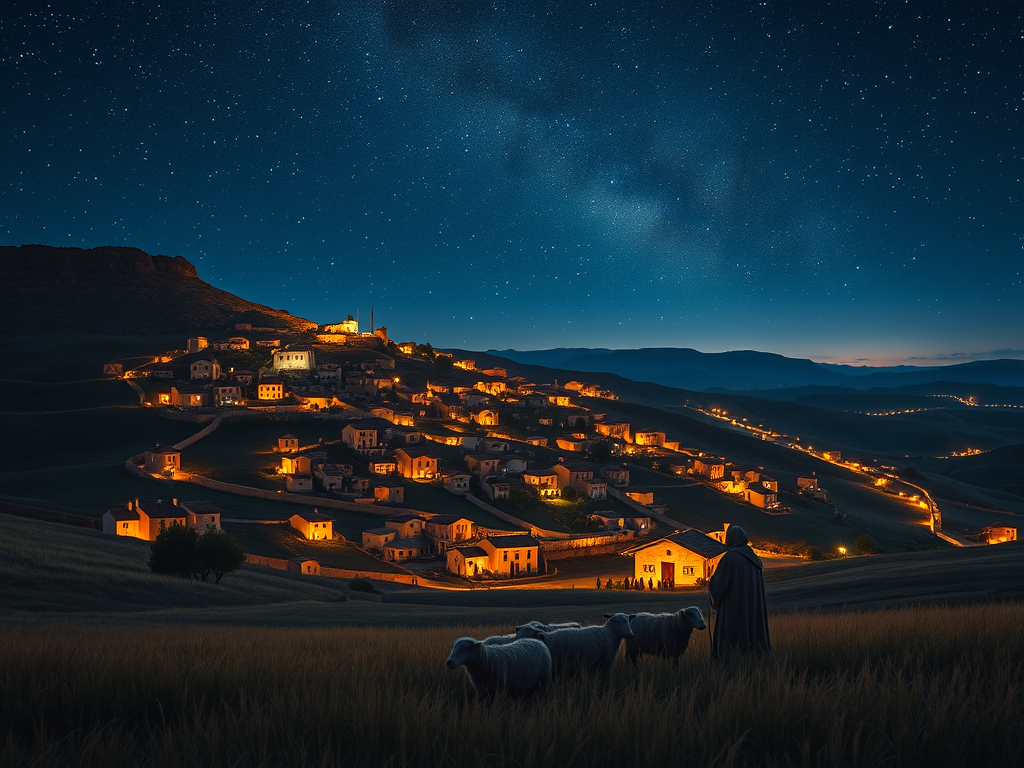
Across the valley, its houses spilling down the hillside, the night lights of Bethlehem shone under a clear starry sky. The town lay 5 miles away from Jerusalem. It was small and unimportant, unlike the city just a few miles to the north where King Herod’s palace and his seat of power were situated.
The town looked out over a fertile plain called Beit Sahour. Further to the east was the Judean Wilderness, and beyond that the Dead Sea. On the fertile plain it was possible to make a successful living as a grain farmer. Once those crops had been harvested all that remained was stubble and a regrowth of weeds. The grain was safely in store. But already the farmers were thinking of the next year’s crop and allowed shepherds to graze their sheep on the stubble and any edible plants that still remained. And in return the sheep fertilised the soil with their droppings.
Poor shepherds! As soon as the stubble was all eaten they would head east with their flocks into the wilderness. There they would seek out little outcrops of grass for the sheep. They needed to be prepared to face off any lions or even bears that fancied a mutton chop. Even on the plain just outside Bethlehem there were tales of lions attacking sheep and shepherds. It was a lonely and somewhat stressful life.
Maybe the distant twinkling lights of the little town were reassuring, but they were also a reminder that normal people were leading comfortable normal lives just a mile or so away. The shepherds were stuck in stubble fields, keeping daft sheep out of trouble.
Except this night was different. As they were keeping watch the sky suddenly got much brighter. This is how Luke describes what happened:
“And behold, an angel of the Lord stood before them, and the glory of the Lord shone around them, and they were greatly afraid.”
These were men who were used to warding off lions and bears, but this was more serious – an angel of the Lord! This is how the story continues:
“Then the angel said to them, “Do not be afraid, for behold, I bring you good tidings of great joy which will be to all people. For there is born to you this day in the city of David a Saviour, who is Christ the Lord. And this will be the sign to you: You will find a Babe wrapped in swaddling cloths, lying in a manger.” And suddenly there was with the angel a multitude of the heavenly host praising God and saying: “Glory to God in the highest, And on earth peace, goodwill toward men!”
“Behold!” That was the second angelic command after the one telling them not to be afraid. It was both a command to listen and also to see something important. It was an invitation and a promise that would involve them doing something extraordinary – to abandon their sheep and to go to Bethlehem.
Luke continues his account:
“So it was, when the angels had gone away from them into heaven, that the shepherds said to one another, “Let us now go to Bethlehem and see this thing that has come to pass, which the Lord has made known to us.” And they came with haste and found Mary and Joseph, and the Babe lying in a manger. “
The angel’s invitation was to “Come and See”. John uses the same phrase in his Gospel. First when Jesus invited his disciples to join him: “They came and saw where He was staying and remained with Him that day”. (Jn1:39)
Then later on Philip, one of Jesus’s new disciples urged the sceptical Nathaniel to “Come and see” and he too became one of Jesus’ disciples. (Jn 1:46)
Later we read of the Samaritan woman at the well. (Jn 4:29) She met Jesus and then returned to the village, saying to her neighbours: “Come, see a Man who told me all the things that I ever did”. Come and See.
Luke draws his shepherd account to a close with these words: “Now when they had seen Him, they made widely known the saying which was told them concerning this Child. And all those who heard it marvelled at those things which were told them by the shepherds. But Mary kept all these things and pondered them in her heart. Then the shepherds returned, glorifying and praising God for all the things that they had heard and seen, as it was told them.”
The angelic command “Behold” draws the shepherds first to “Come and See’ and then to “Go and Tell”.
That “Come and See’ followed by “Go and Tell” is a call to action for us too! Because each of us have our own personal stories to tell, as well as the story of Christ’s coming as both Saviour and Lord to all humankind.
This is an invitation for us to use our own words and our own lives to do the same job and to share with others the promise of eternal life with our heavenly Father through the life, death and resurrection of Jesus. Isn’t it a great opportunity to share this Good News at Christmas!
All references are from the NKJV unless specified otherwise.
John Partis
bearing-kingdom-fruit.com
This article may only be reproduced, in print or on the internet, if the author’s name and website address are included at the end of the article. Thank you.