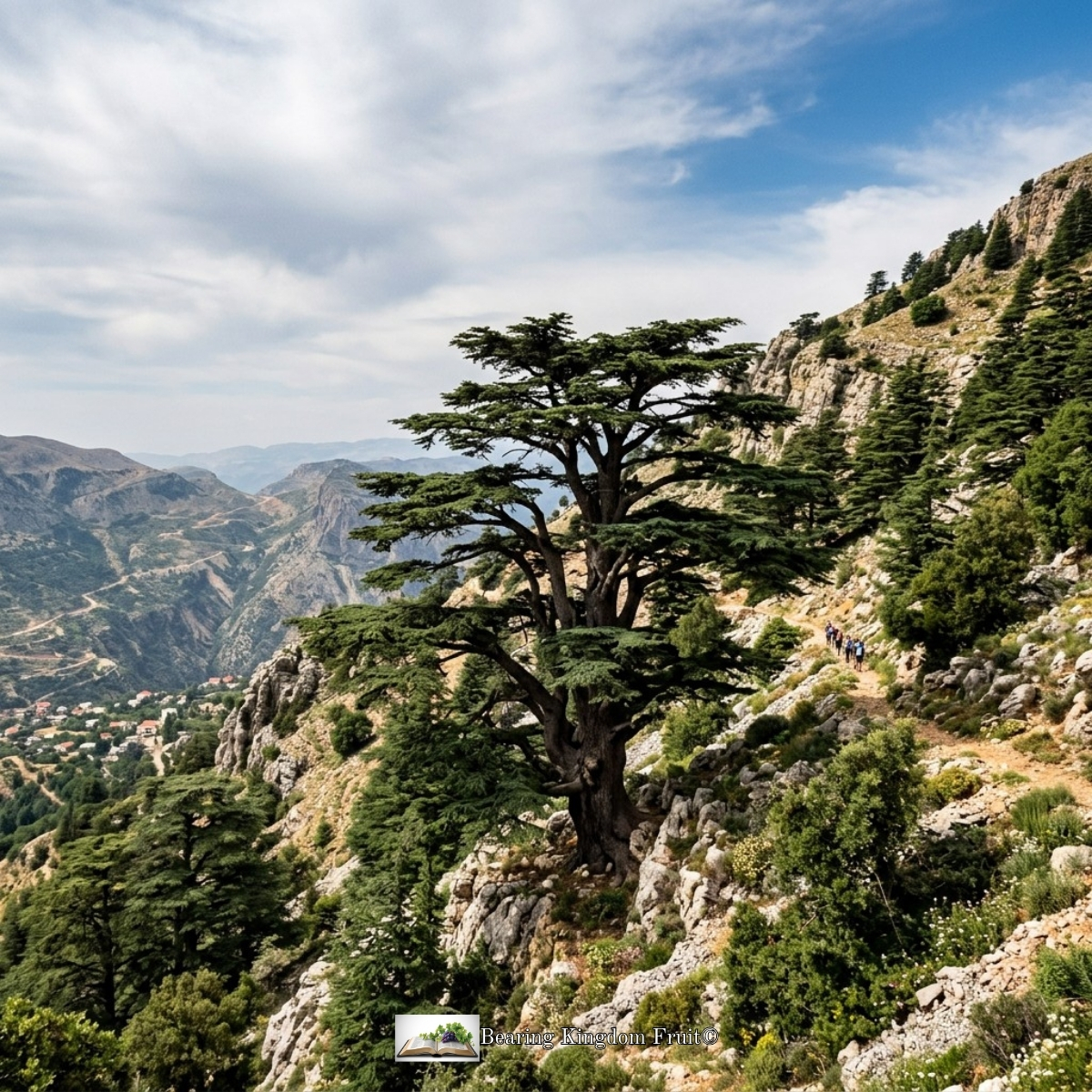
“The trees of the Lord are well watered, the cedars of Lebanon that He planted (Psalm 104:16)
I love trees! I love forests, woods, hedgerows, and best of all, trees growing in solitary splendour. Trees have long featured in my life. I was brought up on a farm of cherry and plum trees. Today’s orchards are serried ranks of small trees closely planted and tightly managed. In the 1950s the orchards were populated with large trees, well spaced apart and mostly left to their own devices – and on the slopes of the North Downs, the grass underneath them grazed by sheep and sometimes even cattle.
The cherry trees were huge. To the diminutive me, they seemed almost like royalty, each one finally yielding up its fruit only by the dangerous work of farm worker’s wives on long swaying ladders, many yards in length.
When I started school in the nearby town of Faversham, it involved a school bus journey; a journey that took me past the largest, most impressive tree I had ever seen at my young age – even more impressive than my noble cherry trees. It was a Cedar of Lebanon that had been flourishing and impressing everyone, growing at the entrance to a farm (and is still growing there some 70 years later!)
Cedars are impressive trees! Botanically, it is generally agreed that there are only three species growing on this earth – Cedrus libani, C. atlantica and C. deodara. Majestic has long been the word used for these beautiful trees.
Cedrus libani, the Cedar of Lebanon, grows into a large, wide spreading tree, only slowly becoming the familiar, flat topped tree with tier upon tier of level (that is horizontally held!) branches of a mature tree.
(Note! Remembering the cedar species: L= level branches = Cedrus libani, D= descending branches = C. deodara, A= ascending branches= C. atlantica)
I’m not sure when I realised the significance of Cedrus libani. It may even have been in the little parish church in our village at Evensong. The words of Psalm 104 are said or sung regularly throughout the year, but especially at Pentecost.
“The trees of the Lord are well watered, the cedars of Lebanon that He planted“ (Psalm 104:16, NIV).
Psalm 104 is a hymn of praise to God, for He is both the Creator and the Upholder of His Creation – the whole Universe. The psalm reminds us of the beauty of the natural world, but also how God sustains it. The psalm echoes the words of the Creation account found in the Book of Genesis. In verse 16 the Cedars of Lebanon are held up as symbols of God’s care and provision for the world He created.
These majestic and wild trees owe their continuing existence entirely to the Divine provision of essentials such as sunshine, water and minerals, rather than to any human effort. The Psalm reminds us that even the most impressive creatures and features of nature are entirely dependent on Him. It is estimated that some of the oldest trees of Cedrus libani, still growing wild in the mountains of Lebanon, are well over 3000 years old. That’s a long time to be sustained!
The Cedar of Lebanon is used symbolically throughout the Old Testament. Throughout it symbolises strength, righteousness and divine majesty. In Psalm 92:12 we find encouragement for ourselves: The verse says that righteous people “will grow like a cedar in Lebanon,”. It means that as we stay faithful and close to the Lord we will stay strong and fruitful – even in our old age. Amen to that!
But let me finish with a word of warning! Prophets like Ezekiel used the towering height of the cedar to describe proud empires or mighty kings, now fallen.
“Indeed Assyria was a cedar in Lebanon, With fine branches that shaded the forest, And of high stature; And its top was among the thick boughs.“(Ezekiel 31:3) Ezekiel was issuing a warning to the Egyptian Pharaoh that he might suffer the same fate. Even Cedars can be cut down – a reminder that human “pride comes before a fall.”
Now the once extensive forests of Lebanon with their majestic stands of cedars are in serious danger and listed as “Vulnerable” on the International Union for Conservation of Nature (IUCN) Red List.
This beautiful tree has things to remind us of: Beware pride but seek righteousness!
All references are from the NKJV unless specified otherwise.
John Partis
bearing-kingdom-fruit.com
This article may only be reproduced, in print or on the internet, if the author’s name and website address are included at the end of the article. Thank you.