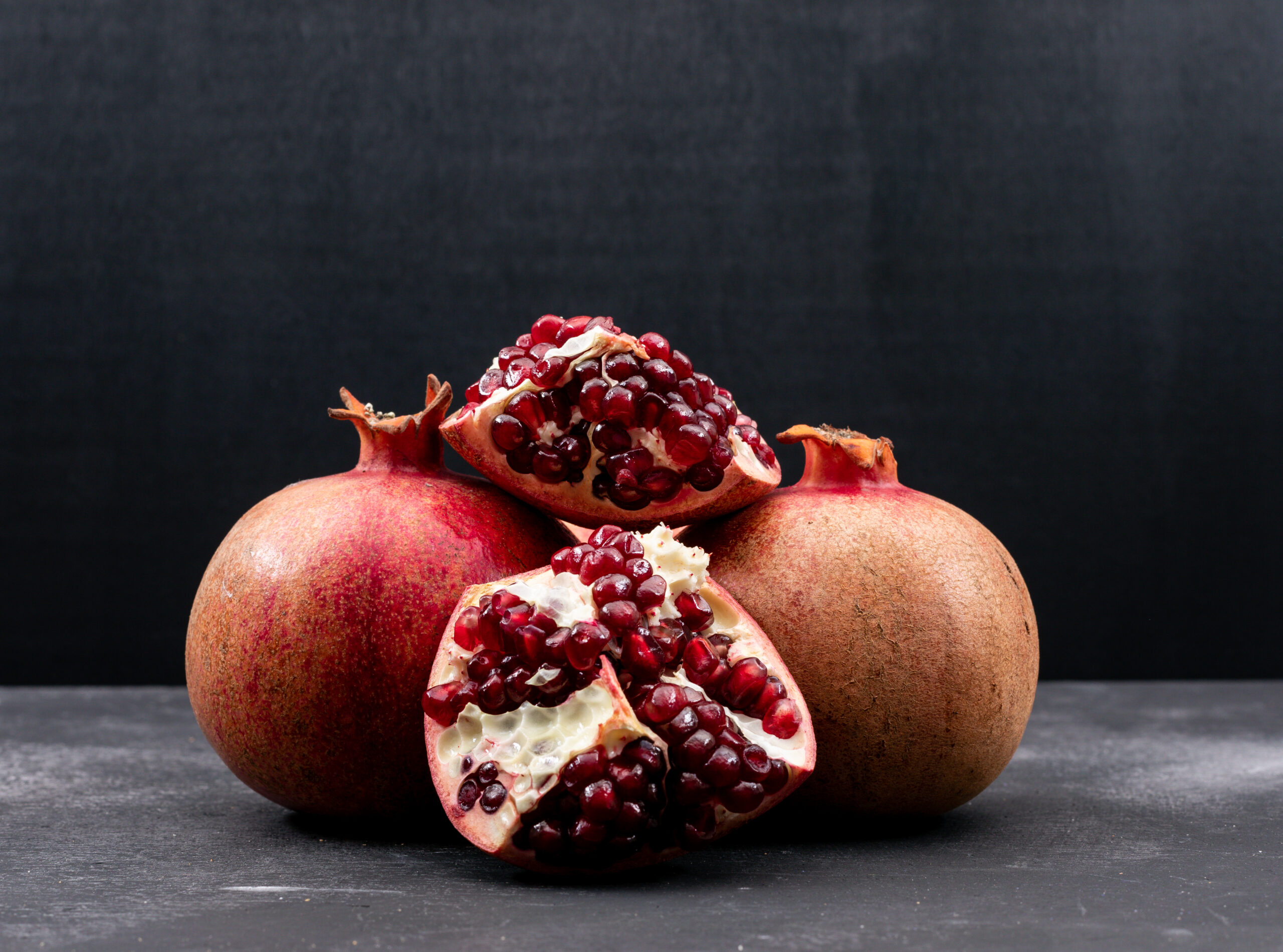
This is Part 1 of a two part reflection. In this first part I reflect on the pomegranate and its role in God’s purposes.
Ouch!
As a volunteer gardener at a local garden open to the public, I was clearing fallen leaves from under a large bush when it attacked me with its vicious thorns, drawing blood even through my thick jumper! My first thought was to question why anyone would grow such a viciously thorny plant for pleasure? Then I noticed that the bush had a label. I read it and things became clearer -“P. granatum” the label said, otherwise known as the Pomegranate. Such a beautiful fruit both to look at and eat, but its branches also furnished with long sharp spiky bits.
The Plant
Punica granatum L. to use its full Latin name, is a large, usually multi-stemmed bush, a species with its centre of origin in Western Asia. But it has been spread further west and east by human intervention over thousands of years. The Silk Road was an ancient trade route from China in the far east to the Mediterranean in the west – and dotted all along its route both to the east and the west you can still find ancient and new pomegranate bushes. Today pomegranates are grown commercially all across the Old World and the New.
Growing in the wild it thrives even in poor soils with little rainfall. It is a decorative plant with its small glossy green leaves that go an intense yellow before falling off in late autumn. It has red flowers and red fruit with an attractive woody exterior and inside are hundreds of fleshy red seeds in a sweet juice. Wonderful, if a bit tricky to eat!
Here at home we turned the seeds into pomegranate juice and used that as a basis for a pomegranate and Dijon mustard sauce to accompany sirloin steak, fondant potatoes and a green salad. Yum!
The UK is too cold to regularly produce edible fruit outside of a heated glasshouse, but I have recently bought a fine example imported from a far warmer country. “Grown in Israel” the sticker said.
A History Of Serving God’s Purpose
Which brings me to the fact that this still much sought after fruit features frequently in the Old Testament of the Bible. It is often used as a symbol of fertility, of abundance, and also of eternal life. You can find it symbolically fashioning the bottom of the robes of the high priest. Its seeds were used as a basis for the design of the Temple in Jerusalem. The pomegranate has deep roots in both Jewish and Christian theology. Here are some verses from Deuteronomy 8:7-10 talking about the land God has promised to Israel:
“For the Lord your God is bringing you into a good land, a land of brooks of water, of fountains and springs, flowing forth in valleys and hills; a land of wheat and barley, of vines and fig trees and pomegranates, a land of olive oil and honey; a land where you will eat food without scarcity, in which you will not lack anything; a land whose stones are iron, and out of whose hills you can dig copper. When you have eaten and are satisfied, you shall bless the Lord your God for the good land which He has given you.”
And the report of the spies Israel later sent out into the land of Canaan confirms this: “When they came to the valley of Eshcol, they cut down a branch with a single cluster of grapes so large that it took two of them to carry it on a pole between them! They also brought back samples of the pomegranates and figs.” (Numbers 13:23, New Living Translation of the Bible.)
The Israelite spies bringing back this fruit was evidence of the land’s fruitfulness, proving God’s abundant provision and desire to bless His people. The pomegranate served a useful purpose.
(In the second Part of this reflection we will explore the problem of spikiness.)
All references are from the NKJV unless specified otherwise.
John Partis
bearing-kingdom-fruit.com
This article may only be reproduced, in print or on the internet, if the author’s name and website address are included at the end of the article. Thank you.